MICOS™ — Official Documentation
What Is MICOS?
MICOS is a modern chess openings classification system developed as an alternative to the ECO (Encyclopaedia of Chess Openings), based on clear grouping principles and exact move-order structure.
MasterInChess Openings System (MICOS) is organized into 5 Main Groups, 57 Opening Groups and 166 Sub Groups, providing a complete and structured classification of all 3,815 recognized chess openings. Within each Opening Group, all openings are arranged strictly by chess notation, ensuring clarity, consistency and ease of learning.
What advantages do you gain by using the MasterInChess Openings System?
By studying and training on MasterInChess.com, players gain a significantly deeper and more structured understanding of chess openings than is possible within the traditional ECO system. MICOS is not an extension of the ECO system. MICOS introduces a fundamentally different classification model based on uniquely defined openings, providing a modern alternative to ECO. MICOS does not classify “main lines” or “variations”. Variations occur only after a MICOS coded opening’s end position.
Over time, the MICOS Coding System is intended to serve as the standard for chess openings.
MICOS Codes have already been tested in chess software environments, where they can be sorted and used to study the chess openings. King’s Pawn Game is shown here as an example:
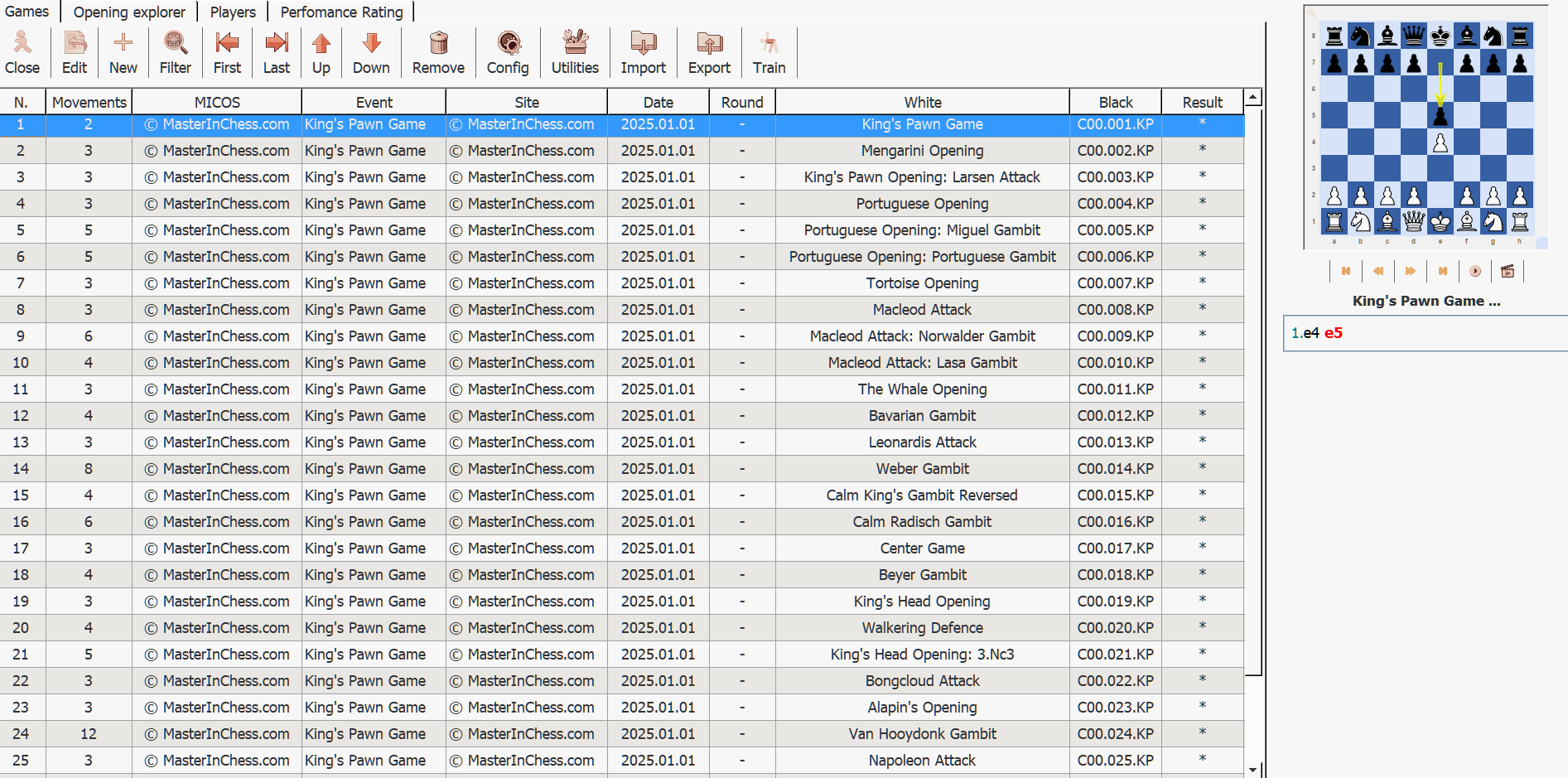
(Click Image to enlarge)
The MICOS database will be updated when newly recognized chess openings appear. New openings will be added at the end of the appropriate Opening Group with the next sequential MICOS Code (MCO).
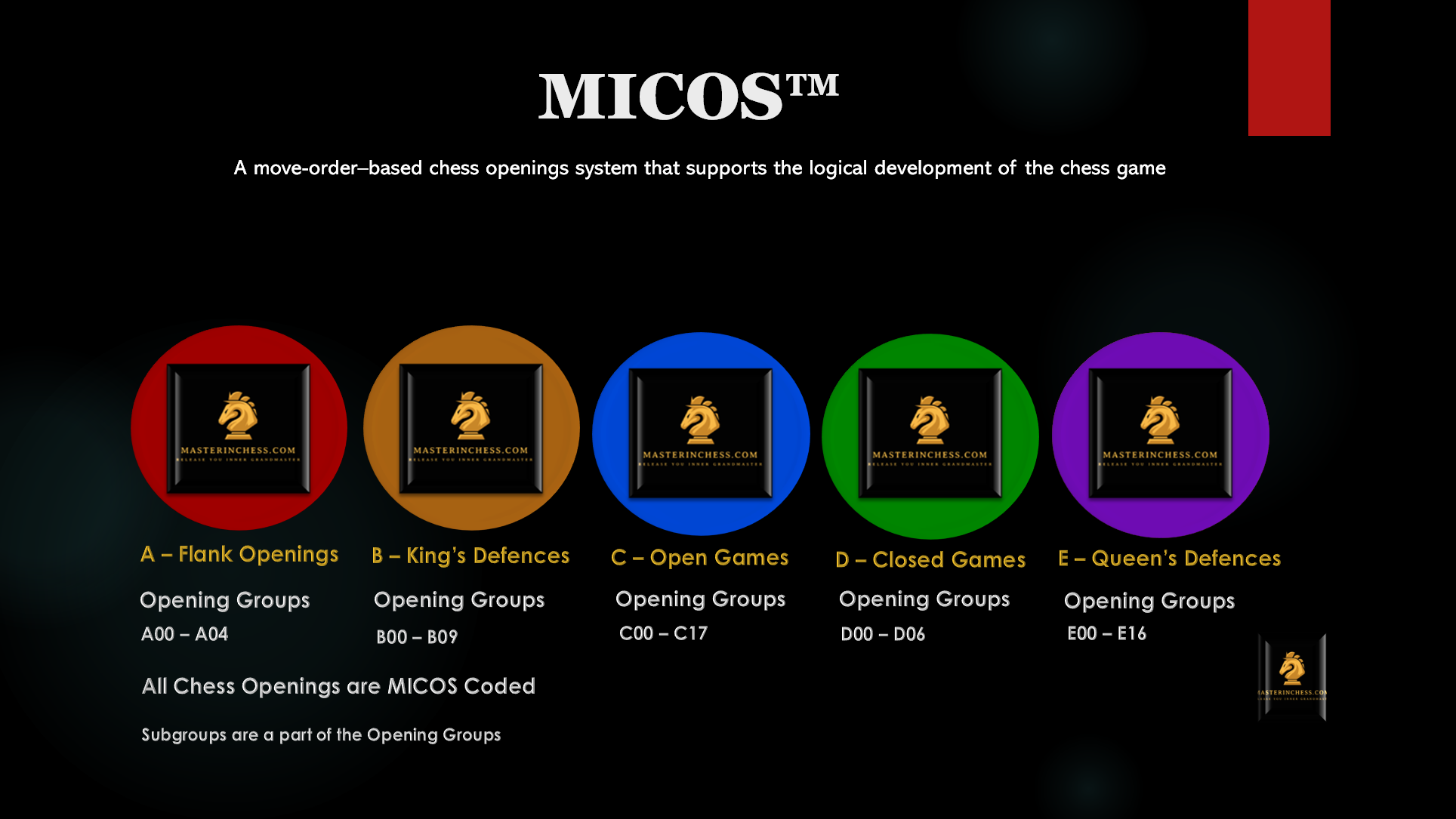
(Click Image to enlarge)
Why MICOS?
MICOS Is Easy to Learn
MICOS combines clarity with professional depth:
-
-
5 Main Opening Groups → instant big-picture overview.
-
57 Opening Groups → instant chess notation overview.
-
166 Sub Groups → human, memorable and recognized sub groups.
-
3,815 MICOS codes → very detailed coverage for study and GM preparation.
-
Logical order → easier to remember and understand.
-
Consistent naming → opening names verified historically and used consistently.
-
Unique positions → each opening has a unique final position.
Precise codes → professionals can prepare deeply.
MasterInChess Openings System (MICOS) does not use terms like “Main Line” or “Variant” as classification categories.
In MICOS, each recognized chess opening is unique and receives one permanent MICOS Code (MCO).
If new theoretical discoveries arise from a recognized opening, they are added as new unique openings, not “variants.”
This eliminates ambiguity found in other systems like ECO, where many unrelated positions are grouped under the same code.
You are welcome to display and discuss MasterInChess Openings System in educational content such as YouTube videos, chess articles and non-commercial websites.
When using openings from the MasterInChess Openings System, the corresponding MICOS Code (MCO) must be included and MasterInChess.com must be credited as the source.
The MICOS database and classification system are protected by international copyright law and may not be integrated into chess programs, applications, or commercial products without explicit written permission from MasterInChess.
MICOS is a dynamic system that adapts and expands as opening theory evolves.
All openings are arranged strictly by chess notation within each of the 57 Opening Groups.
This structure mirrors the natural flow of the game and creates a consistent framework for deep study, training and future integration into chess programs.
A chess opening notation is unique — and so is its MICOS Code (MCO).
Each MICOS Code (MCO) is permanently linked to a specific sequence of moves.
While opening names may change over time, the MICOS Code (MCO) and its underlying notation will never change. New openings are always placed inside their existing Opening Group, at the end of that group’s move sequence, using the next available MICOS Code (MCO).
The MICOS system includes only recognized chess openings that are historically documented, widely accepted and tested in practical play.
If two move sequences reach the same final position, only the historically recognized move order is included in MICOS.
This ensures that every MICOS opening remains unique, providing players with a reliable and standardized classification system.
MICOS allows you to identify exactly which Opening Group and which specific opening your opponent prefers, based on their previous games.
This gives you a far deeper preparation advantage than ECO, where a single code may contain dozens or hundreds of unrelated openings.
Using the Search Openings – Database, you can enter the notation from the start of any game and instantly find the specific opening or defence your opponent tends to play.
The MICOS database currently contains 3,815 recognized openings.
Over time, each opening will receive its own page including:
-
a description
-
video instruction from coaches and Grandmasters
-
training guidance
-
memory techniques
-
repertoire building for White and Black
The MICOS Code (MCO) is the key to understanding and training every opening.
MICOS does not use “main lines” or “variations” — MICOS only use unique, recognized chess openings.
MICOS does not operate with the traditional terms “main line” or “variation” as used in the ECO system.
In the old ECO system, a single opening often contains:
-
a so-called main line, and
-
dozens of loosely grouped variations
This approach creates ambiguity and overlapping classifications.
MICOS works differently.
In MICOS:
-
Every recognized chess opening is classified as its own independent opening
-
Each recognized opening receives one fixed MICOS Code (MCO)
-
A MICOS Code (MCO) always represents a complete opening position, not a branch of another opening
Variations begin only after a MICOS coded opening has been reached.
Example
Bird’s Opening
Dutch Defence: Batavo Gambit
MCO: A03.015.BI
Opening moves:
This position defines the complete and recognized opening and therefore receives one MICOS Code (MCO).
Any continuation after this point, such as:
-
4.Nc6
-
4.Ne5
-
4.Ng5
are variations of the Batavo Gambit, but they do not receive separate MICOS Codes unless they later become historically recognized as independent openings.
MICOS is the first complete and logically structured mapping of all recognized chess openings.
It provides a modern, scalable classification system that is easy to learn and easy to use for humans, chess programs and databases.
At the core, MICOS can be understood through two clear paths:
-
Structural path:
5 Main Groups → 57 Opening Groups → 3,815 MICOS coded chess openings.Example of a MICOS Code (MCO):
Mieses Opening — A00.053.IO
1.d3 - Sub Group path:
57 Opening Groups → 166 Sub Groups → Groups defined by MICOS code (MCO) ranges.
Example: Bird’s Opening: From Gambit, MICOS code (MCO) range A03.016.BI – A03.024.BI.
Sub Groups are included in MICOS and are defined by MICOS code (MCO) ranges. They are not a separate system.
🔒 MICOS is Copyright Protected
The MasterInChess Openings System (MICOS) is officially registered and protected by international copyright law.
Every MICOS Code (MCO), Opening Group and Sub Group is part of a structured and verified system — recognized as a modern alternative to the traditional ECO classification.
For full documentation of the copyright registration, see:
👉 MasterInChess Openings System – MICOS Copyright Protection
MICOS vs ECO (Historical Context)
The classical ECO system contains 500 codes (A00–E99) and served chess for many decades.
To help readers understand the evolution from the classical system to MICOS, the full ECO list is preserved here:
👉 The 500 ECO Codes (Classical System)
MICOS builds on modern opening theory with a complete, logical structure and full coverage of all known openings.
Confusion arises because chess websites, the internet and chess programs often place openings in the wrong ECO group. It’s impossible with MICOS, as it only has unique openings.
With MICOS, it is always clear how many openings exist within each opening group, as each opening is assigned its own MICOS code (MCO). In the old ECO system from 1966, it is not possible to determine exactly how many distinct openings are contained within a single ECO code.
MICOS is the ultimate opening system—a dynamic opening system.
Example of why the ECO system is not logical and can be confusing. In example MICOS grouping of the Indian Game vs ECO:
| ECO Code | MICOS Code (MCO) | Opening Name | Chess Notation |
|---|---|---|---|
| A46 | E05.075.IN | Yusupov Attack - Rubinstein System | 1.d4 Nf6 2.Nf3 e6 3.e3 |
| D00 | E05.076.IN | Richter-Veresov Attack - Classical Defence | 1.d4 Nf6 2.Nf3 e6 3.Nc3 d5 4.Bg5 |
| A49 | E05.077.IN | Pseudo King's Indian Defence | 1.d4 Nf6 2.Nf3 g6 |
| A48 | E05.078.IN | London System 3.Bf4 with 2…g6 | 1.d4 Nf6 2.Nf3 g6 3.Bf4 |
| A48 | E05.079.IN | London System 4.Nbd2 | 1.d4 Nf6 2.Nf3 g6 3.Bf4 Bg7 4.Nbd2 |
| A48 | E05.080.IN | Torre Attack: Fianchetto Defence | 1.d4 Nf6 2.Nf3 g6 3.Bg5 |
| A48 | E05.081.IN | Torre Attack: Fianchetto Defence - Euwe Defence | 1.d4 Nf6 2.Nf3 g6 3.Bg5 Bg7 4.Nbd2 c5 |
| D00 | E05.082.IN | Torre Attack: Grunfeld Defence | 1.d4 Nf6 2.Nf3 g6 3.Bg5 Bg7 4.Nbd2 d5 5.e3 0-0 |
| A48 | E05.083.IN | Colle System: Grunfeld Formation | 1.d4 Nf6 2.Nf3 g6 3.e3 Bg7 4.Bd3 d5 |
| A48 | E05.084.IN | Colle System: King's Indian Defence | 1.d4 Nf6 2.Nf3 g6 3.e3 Bg7 4.Bd3 d6 |
| A49 | E05.085.IN | Przepiorka Defence | 1.d4 Nf6 2.Nf3 g6 3.g3 |
| D00 | E05.086.IN | Barry Attack | 1.d4 Nf6 2.Nf3 g6 3.Nc3 d5 4.Bf4 |
| D02 | E05.087.IN | Barry Attack: Grunfeld Attack | 1.d4 Nf6 2.Nf3 g6 3.Nc3 d5 4.Bf4 Bg7 5.e3 0-0 6.Be2 |
| D00 | E05.088.IN | Barry Attack: Tarzan Attack | 1.d4 Nf6 2.Nf3 g6 3.Nc3 d5 4.Bf4 Bg7 5.Qd2 |
| A46 | E05.089.IN | Doery Defence | 1.d4 Nf6 2.Nf3 Ne4 |
ECO is a trademark of Chess Informant, used here solely for reference purposes.
MICOS has 57 Opening Groups that follow chess notation and are easy to remember.
The ECO system contains 500 codes, which makes it difficult for most players to understand or memorize.
For example, ECO has 40 categories (E60–E99) for the King’s Indian Defence, while MICOS places all recognized King’s Indian Defences in one Opening Group (E15.KI) and sorts them by notation.
The common opening notation for the King’s Indian Defence is 1.d4 Nf6 2.c4 g6 — there is no reason to split this single, well-defined opening across 40 ECO categories instead of one Opening Group.
Chess programs do not agree on where to place openings in the old ECO system— the same opening may appear as ECO A42 in one program and B06 in another.
In MICOS, misplacement is impossible: each opening receives one unique MICOS Code (MCO). Once assigned, the code never changes, while the system remains dynamic and can expand logically as opening theory evolves.
MICOS is much easier to understand and use. ECO is complex, illogical, and lacks any consistent alphabetical or move-order structure. For example, many 1.d4 openings—clearly center openings—are placed under ECO’s “Flank Openings,” which makes no logical sense. Benko Gambit, Old Indian Defence, and Dutch Defence are also grouped in ways that do not reflect their actual nature.
MICOS organizes these openings logically: all 1.d4 openings without …d5 belong naturally in the Irregular Queen’s Defences, and MICOS places them exactly there.
The entire system follows the structure of the opening moves, producing a natural flow and a clearer understanding of how openings relate to each other.
Chess Informant aimed to fit all openings into 500 ECO codes, but the result often feels arbitrary, artificial, and shaped to fit a fixed 500-category structure.
MICOS takes the opposite approach: openings are grouped strictly by chess notation and logic, producing a more intuitive and user-friendly system.
MICOS consists of 57 Opening Groups, compared to ECO’s 500 categories. While ECO classifies only 500 openings, MICOS provides a far deeper and broader classification with 3,815 recognized openings today.
Why it is important to learn and play the recognized chess openings
The recognized chess openings have been collected from 1600 and up to today. MICOS is the world’s largest database with all recognized chess openings.
Why use MICOS? Because recognized openings are proven in practice and have historically scored more wins than the positions played against them.
Mastering a recognized opening gives you a solid foundation for the rest of the game, increasing your ability to outplay opponents who are less familiar with these structures.
A recognized opening lets you dictate the flow early, creating the foundation on which the rest of the game is built. Conversely, neglecting opening principles often leads to weak positions, making it difficult to defend or attack effectively.
You do not need to train every opening, but you may discover an opening in MICOS that you will not find anywhere else. A single opening that fits your style can raise your win rate dramatically. If your opponent does not know the opening — or does not know how to respond — they will feel uncertain from the very beginning, giving you a natural advantage.
MICOS includes all openings found on chess.com and lichess.org — and MICOS got 25% more openings (lichess.org) to 35% (chess.com) recognized chess openings that only MICOS covers.
Why are we “allowed” to call every MICOS opening unique?
A MICOS opening is defined as unique when its move-order structure results in a final position not shared by any other MICOS opening.
The database enforces position-level uniqueness while preserving structural distinctions in chess notation.
For example, there are exactly 179 irregular openings, each with its own MICOS Code (MCO).
Most chess websites mix about 100 of these into one “A00” box. In MICOS, each one stands on its own — with its own history, its own games, and its own identity.
This gives you far better preparation: you can study exactly the openings your opponent has played, with precision for both White and Black.
Conditions for submitting a Recognized Chess Opening to MasterInChess.com for inclusion in the MICOS database
If you want a recognized chess opening to be included in the MICOS Opening Database, you must provide a reliable source and the historical background of the opening. You can send your suggestion to us here. Contact: [email protected]
Example: Albin Counter-Gambit — 1.d4 d5 2.c4 e5 (MICOS D01.014.QD)
In 1893, in New York, Adolf Albin (1848–1920) introduced a provocative idea against Emanuel Lasker. With 2…e5, now known as the Albin Counter-Gambit, he pushed a second, undefended central pawn.
After 3.dxe5, Black’s idea is the bold 3…d4, restricting White’s knight from developing to c3 and claiming central space. Not exactly a modest plan.
If White tries 4.e3, they risk falling into one of the oldest opening traps:
4…Bb4+ 5.Bd2 dxe3, offering the bishop.
If 6.Bxb4? exf2+ 7.Ke2, then comes the shocker:
7…fxg1=N+!
Modern theory still finds promising play for Black in several positions.
Source: ChessBase.
Learn more about the Albin Counter-Gambit here on MasterInChess.com.
Correct Move Orders — Why MICOS Fixes What Other Systems Get Wrong
In January 2025, we analyzed openings on Lichess.org and found that many openings were listed with incorrect move orders inside their groups.
These deviations do not match historically recognized sequences.
Example — King’s Indian Defence: King’s Knight Attack
Lichess lists the chess notation as:
➡️ 1.d4 Nf6 2.Nf3 g6 3.c4
However, the historically correct move order is:
✔️ 1.d4 Nf6 2.c4 g6 3.Nf3
Such inaccuracies lead to misclassification and incorrect theoretical references.
MICOS Coding System prevents this.
Every opening is recorded with its correct, historically recognized move sequence, providing an accurate and structured reference for chess players, databases, and chess programs.
Short Codes
The short codes are built into the MICOS Codes, so you immediately know which Opening Group an opening belongs to — and which groups your opponent prefers to play. This makes opening preparation much easier.
Short codes are usually the first two letters of the Opening Group name.
For example:
-
EN = English Opening
-
BI = Bird’s Opening
-
RE = Réti Opening
In a few cases, the code uses the first letter of each word.
For example:
-
ND = Nimzowitsch Defence (because NI is already used for the Nimzo-Indian Defence)
Color System in MICOS
The MICOS color system assigns a distinct color to each Main Group to support clarity, orientation, and rapid recognition across the system.
They help players instantly recognize the type of position they are entering and support intuitive learning across the system.
Color: Red — Flank Openings
Red symbolizes danger, surprise, and unpredictability, making it ideal for flank openings.
These openings avoid the classical 1.e4 and 1.d4 routes, often catching opponents off guard and pulling them into unfamiliar structures.
Flank openings can be challenging for beginners but are extremely powerful in the hands of prepared players.
Examples:
Nimzo–Larsen Attack (1.b3)
Anderssen’s Opening (1.a4)
Color: Brown — King’s Defences (1.e4 without …e5)
Brown symbolizes the classical chessboard and solid foundations.
King’s Defences emphasize resilience, structure, and strategic counterplay against 1.e4 without mirroring White’s central occupation.
They form a major part of modern chess understanding and teach key positional and structural principles.
Color: Blue — Open Games (1.e4 e5)
Blue symbolizes the open ocean — wide, dynamic, and constantly changing.
Open Games lead to open files, rapid development, and sharp tactical battles.
They reward accurate calculation, initiative, and adaptability.
Color: Green — Closed Games (1.d4 d5)
Green symbolizes growth, stability, and long-term planning.
Closed Games develop more slowly and emphasize pawn structure, space, and strategic maneuvering.
They reward patience, deep understanding, and long-term thinking.
Color: Purple — Queen’s Defences (1.d4 without …d5)
Purple symbolizes strategic depth, authority, and complexity.
Queen’s Defences often lead to rich, flexible structures with long-term counterplay.
They require foresight, positional understanding, and the ability to navigate subtle imbalances.
These openings may appear irregular at first, but they frequently result in highly resilient and strategically sophisticated positions.
General Note on Colors
The MICOS color system reflects the psychology, strategy, and mindset associated with each family of openings.
Colors are not decorative — they are functional.
They help players intuitively grasp the character of a position and choose openings that match their temperament and playing style.
MICOS uses color only to express Main Group meaning.
Sub Groups are structural, not semantic.
MICOS™ is a proprietary chess openings classification system developed and maintained by MasterInChess
The MasterInChess Openings System (MICOS) is protected by international copyright law.
Copyright © 2025 – 2026 MasterInChess. All rights reserved.
The MICOS classification structure, opening codes, system layout and all related textual material are protected intellectual property.
MICOS 57 Opening Groups
MICOS 166 Sub Groups
| Main & Sub Groups | Chess Notation | Openings in MICOS CAP |
|---|---|---|
Flank Openings | ||
| Irregular Openings (A00.IO) | ||
| 1. Anderssen’s Opening | 1.a3 | A00.001.IO |
| 2. Ware Opening | 1.a4 | A00.007.IO |
| 3. Polish Opening | 1.b4 | A00.016.IO |
| 4. Saragossa Opening | 1.c3 | A00.049.IO |
| 5. Mieses Opening | 1.d3 | A00.053.IO |
| 6. Van't Kruijs Opening | 1.e3 | A00.059.IO |
| 7. Barnes Opening | 1.f3 | A00.067.IO |
| 8. Hungarian Opening | 1.g3 | A00.073.IO |
| 9. Grob Opening | 1.g4 | A00.095.IO |
| 10. Clemenz Opening | 1.h3 | A00.118.IO |
| 11. Kadas Opening | 1.h4 | A00.121.IO |
| 12. Sodium Attack | 1.Na3 | A00.131.IO |
| 13. Van Geet Opening | 1.Nc3 | A00.135.IO |
| 14. Amar Opening | 1.Nh3 | A00.175.IO |
| English Opening (A02.EN) | ||
| 15. Symmetrical Defence | 1.c4 c5 | A02.004.EN |
| 16. Anglo-Slav Defence (Minor Sub Group) | 1.c4 d5 | A02.041.EN |
| 17. King's English | 1.c4 e5 | A02.046.EN |
| 18. Agincourt Defence | 1.c4 e6 | A02.103.EN |
| 19. Anglo-Dutch Defence | 1.c4 e6 | A02.128.EN |
| 20. Anglo-Indian Defence | 1.c4 Nf6 | A02.142.EN |
| Bird's Opening (A03.BI) | ||
| 21. Dutch Defence | 1.f4 d5 | A03.003.BI |
| 22. From's Gambit | 1.f4 e5 | A03.016.BI |
| Reti Opening (A04.RE) | ||
| 23. Anglo-Slav Defence | 1.Nf3 d5 2.c4 c6 3.b3 | A04.023.RE |
| 24. King's Indian Attack | 1.Nf3 d5 2.g3 | A04.042.RE |
King's Defences | ||
| Irregular King's Defences (B00.IK) | ||
| 25. St. George Defence | 1.e4 a6 | B00.004.IK |
| 26. Owen's Defence | 1.e4 b6 | B00.010.IK |
| Sicilian Defence (B01.SI) | ||
| 27. Wing Gambit | 1.e4 c5 2.b4 | B01.008.SI |
| 28. Alapin Attack | 1.e4 c5 2.c3 | B01.018.SI |
| 29. Smith-Morra Gambit | 1.e4 c5 2.d4 | B01.033.SI |
| 30. Closed Sicilian | 1.e4 c5 2.Nc3 e6 | B01.077.SI |
| 31. Closed Fianchetto | 1.e4 c5 2.Nc3 Nc6 3.g3 | B01.084.SI |
| 32. O'Kelly Defence | 1.e4 c5 2.Nf3 a6 | B01.099.SI |
| 33. Canal Attack | 1.e4 c5 2.Nf3 d6 3.Bb5+ | B01.124.SI |
| 34. Najdorf Defence | 1.e4 c5 2.Nf3 d6 3.d4 cxd4 4.Nxd4 Nf6 5.Nc3 a6 | B01.145.SI |
| 35. Scheveningen Defence | 1.e4 c5 2.Nf3 d6 3.d4 cxd4 4.Nxd4 Nf6 5.Nc3 e6 | B01.174.SI |
| 36. Sicilian Dragon | 1.e4 c5 2.Nf3 d6 3.d4 cxd4 4.Nxd4 Nf6 5.Nc3 g6 | B01.201.SI |
| 37. Classical Attack | 1.e4 c5 2.Nf3 d6 3.d4 cxd4 4.Nxd4 Nf6 5.Nc3 Nc6 6.Be2 | B01.243.SI |
| 38. Richter-Rauzer Attack | 1.e4 c5 2.Nf3 d6 3.d4 cxd4 4.Nxd4 Nf6 5.Nc3 Nc6 6.Bg5 | B01.248.SI |
| 39. Caro-Kann Defence | 1.e4 c5 2.Nf3 e6 3.d4 cxd4 4.Nxd4 a6 | B01.287.SI |
| 40. Paulsen Defence | 1.e4 c5 2.Nf3 e6 3.d4 cxd4 4.Nxd4 Nc6 | B01.302.SI |
| 41. Hyperaccelerated Pterodactyl Defence | 1.e4 c5 2.Nf3 g6 3.d4 Bg7 | B01.331.SI |
| 42. Nyezhmetdinov-Rossolimo Attack | 1.e4 c5 2.Nf3 Nc6 3.Bb5 | B01.343.SI |
| 43. Open Sicilian | 1.e4 c5 2.Nf3 Nc6 3.d4 | B01.351.SI |
| 44. Nimzowitsch Defence | 1.e4 c5 2.Nf3 Nf6 | B01.383.SI |
| Caro-Kann Defence (B02.CK) | ||
| 45. Accelerated Panov Attack | 1.e4 c6 2.c4 | B02.008.CK |
| 46. Advance Attack | 1.e4 c6 2.d4 d5 3.e5 | B02.022.CK |
| 47. Panov Attack | 1.e4 c6 2.d4 d5 3.exd5 cxd5 4.c4 | B02.035.CK |
| 48. Classical Defence | 1.e4 c6 2.d4 d5 3.Nc3 dxe4 4.Nxe4 Bf5 | B02.058.CK |
| 49. Karpov Defence | 1.e4 c6 2.d4 d5 3.Nc3 dxe4 4.Nxe4 Nd7 | B02.068.CK |
| 50. Two Knights Attack | 1.e4 c6 2.Nc3 d5 3.Nf3 | B02.097.CK |
| Scandinavian Defence (B03.SC) | ||
| 51. Portuguese Gambit | 1.e4 d5 2.exd5 Nf6 3.d4 Bg4 | B03.012.SC |
| 52. Anderssen Counter-Attack | 1.e4 d5 2.exd5 Qxd5 3.Nc3 Qa5 4.d4 e5 | B03.033.SC |
| 53. Mieses Defence | 1.e4 d5 2.exd5 Qxd5 3.Nc3 Qa5 4.d4 Nf6 | B03.037.SC |
| Pirc Defence (B04.PI) | ||
| 54. Austrian Attack | 1.e4 d6 2.d4 Nf6 3.Nc3 g6 4.f4 | B04.019.PI |
| 55. Classical Quiet System | 1.e4 d6 2.d4 Nf6 3.Nc3 g6 4.Nf3 | B04.028.PI |
| French Defence (B05.FR) | ||
| 56. St. George Defence (Minor Sub Group) | 1.e4 e6 2.d4 a6 | B05.013.FR |
| 57. Advance Opening | 1.e4 e6 2.d4 d5 3.e5 | B05.025.FR |
| 58. Exchange Attack | 1.e4 e6 2.d4 d5 3.exd5 | B05.045.FR |
| 59. Steinitz Defence (Minor Sub Group) | 1.e4 e6 2.d4 d5 3.Nc3 a6 4.Nf3 Nf6 5.e5 Nfd7 | B05.052.FR |
| 60. Winawer Defence | 1.e4 e6 2.d4 d5 3.Nc3 Bb4 | B05.056.FR |
| 61. Rubinstein Defence | 1.e4 e6 2.d4 d5 3.Nc3 dxe4 | B05.095.FR |
| 62. MacCutcheon Defence | 1.e4 e6 2.d4 d5 3.Nc3 Nf6 4.Bg5 Bb4 | B05.108.FR |
| 63. Classical Defence | 1.e4 e6 2.d4 d5 3.Nc3 Nf6 4.Bg5 Be7 | B05.121.FR |
| 64. Tarrasch Attack | 1.e4 e6 2.d4 d5 3.Nd2 | B05.151.FR |
| Robatsch Defence (B06.RO) | ||
| 65. Central Benoni | 1.e4 g6 2.d4 Bg7 3.c4 c5 | B06.008.RO |
| 66. Semi-Averbakh Defence | 1.e4 g6 2.d4 Bg7 3.c4 c5 4.Nf3 | B06.012.RO |
| Pterodactyl Defence (B07.PT) | ||
| 67. Sicilian Defence (Minor Sub Group) | 1.e4 g6 2.d4 Bg7 3.Nc3 c5 4.Nf3 Qa5 | B07.010.PT |
| Nimzowitsch Defence (B08.ND) | ||
| 68. Scandinavian Advance Attack | 1.e4 Nc6 2.d4 d5 3.e5 | B08.009.ND |
| 69. Kennedy Defence | 1.e4 Nc6 2.d4 e5 | B08.022.ND |
| 70. El Columpio Defence (Minor Sub Group) | 1.e4 Nc6 2.Nf3 Nf6 3.e5 Ng4 | B08.043.ND |
| Alekhine Defence (B09.AL) | ||
| 71. Hunt Attack | 1.e4 Nf6 2.e5 Nd5 3.c4 Nb6 4.c5 Nd5 | B09.012.AL |
| 72. Four Pawns Attack | 1.e4 Nf6 2.e5 Nd5 3.d4 d6 4.c4 Nb6 5.f4 | B09.027.AL |
| 73. Modern Defence | 1.e4 Nf6 2.e5 Nd5 3.d4 d6 4.Nf3 | B09.036.AL |
Open Games | ||
| Bishop's Opening (C01.BS) | ||
| 74. McDonnell Gambit (Minor Sub Group) | 1.e4 e5 2.Bc4 Bc5 3.b4 | C01.005.BS |
| 75. Berlin Defence | 1.e4 e5 2.Bc4 Nf6 | C01.025.BS |
| Center Game (C02.CG) | ||
| 76. Danish Gambit | 1.e4 e5 2.d4 exd4 3.c3 | C02.004.CG |
| King's Gambit Declined (C03.KD) | ||
| 77. Classical Defence | 1.e4 e5 2.f4 Bc5 | C03.002.KD |
| 78. Falkbeer Counter-Gambit | 1.e4 e5 2.f4 d5 | C03.015.KD |
| 79. Panteldakis Counter-Gambit | 1.e4 e5 2.f4 f5 | C03.038.KD |
| King's Gambit Accepted (C04.KA) | ||
| 80. Bishop's Gambit | 1.e4 e5 2.f4 exf4 3.Bc4 | C04.004.KA |
| 81. Cunningham Defence | 1.e4 e5 2.f4 exf4 3.Nf3 Be7 | C04.046.KA |
| 82. Muzio Gambit | 1.e4 e5 2.f4 exf4 3.Nf3 g5 4.Bc4 g4 5.0-0 | C04.068.KA |
| 83. Kieseritzky Gambit | 1.e4 e5 2.f4 exf4 3.Nf3 g5 4.h4 g4 5.Ne5 | C04.101.KA |
| 84. Allgaier Gambit | 1.e4 e5 2.f4 exf4 3.Nf3 g5 4.h4 g4 5.Ng5 | C04.125.KA |
| Vienna Game (C05.VI) | ||
| 85. Vienna Gambit with 2…Nc6 | 1.e4 e5 2.Nc3 Nc6 3.f4 | C05.012.VI |
| 86. Vienna Gambit with 2…Nf6 | 1.e4 e5 2.Nc3 Nf6 3.f4 | C05.048.VI |
| King's Knight Opening (C06.KN) | ||
| 87. Elephant Gambit | 1.e4 e5 2.Nf3 d5 | C06.006.KN |
| 88. Latvian Gambit | 1.e4 e5 2.Nf3 f5 | C06.010.KN |
| 89. Taylor Opening | 1.e4 e5 2.Nf3 Nc6 3.Be2 | C06.043.KN |
| Philidor Defence (C07.PH) | ||
| 90. Philidor Counter-Gambit | 1.e4 e5 2.Nf3 d6 3.d4 f5 | C07.019.PH |
| 91. Hanham Defence | 1.e4 e5 2.Nf3 d6 3.d4 Nd7 | C07.023.PH |
| 92. Nimzowitsch Defence | 1.e4 e5 2.Nf3 d6 3.d4 Nf6 | C07.035.PH |
| Ruy Lopez Opening (C08.RL) | ||
| 93. Morphy's Defence | 1.e4 e5 2.Nf3 Nc6 3.Bb5 a6 | C08.003.RL |
| 1.e4 e5 2.Nf3 Nc6 3.Bb5 a6 ...5.d5, ...5.d6, ...5.g6 | C08.108.RL | |
| 1.e4 e5 2.Nf3 Nc6 3.Bb5 a6 with various move 5. | C08.148.RL | |
| 94. Closed Defence | 1.e4 e5 2.Nf3 Nc6 3.Bb5 a6 4.Ba4 Nf6 5.0-0 Be7 | C08.036.RL |
| 95. Open Ruy Lopez | 1.e4 e5 2.Nf3 Nc6 3.Bb5 a6 4.Ba4 Nf6 5.0-0 Nxe4 | C08.114.RL |
| 96. Exchange Attack | 1.e4 e5 2.Nf3 Nc6 3.Bb5 a6 4.Bxc6 | C08.158.RL |
| 97. Classical Defence | 1.e4 e5 2.Nf3 Nc6 3.Bb5 Bc5 | C08.172.RL |
| 98. Schliemann Defence | 1.e4 e5 2.Nf3 Nc6 3.Bb5 f5 | C08.191.RL |
| 99. Berlin Defence | 1.e4 e5 2.Nf3 Nc6 3.Bb5 Nf6 | C08.210.RL |
| Giuoco Piano Game (C10.GI) | ||
| 100. Giuoco Pianissimo Attack: 5.d3 | 1.e4 e5 2.Nf3 Nc6 3.Bc4 Bc5 4.c3 Nf6 5.d3 | C10.012.GI |
| 101. Greco Gambit | 1.e4 e5 2.Nf3 Nc6 3.Bc4 Bc5 4.c3 Nf6 5.d4 | C10.025.GI |
| 102. Giuoco Pianissimo Attack: 4.d3 | 1.e4 e5 2.Nf3 Nc6 3.Bc4 Bc5 4.d3 | C10.047.GI |
| Two Knights Game (C12.TW) | ||
| 103. Scotch Gambit | 1.e4 e5 2.Nf3 Nc6 3.Bc4 Nf6 4.d4 exd4 5.0-0 | C12.011.TW |
| Scotch Game (C14.SG) | ||
| 104. Scotch Gambit | 1.e4 e5 2.Nf3 Nc6 3.d4 exd4 4.Bc4 | C14.004.SG |
| 105. Goering Gambit | 1.e4 e5 2.Nf3 Nc6 3.d4 exd4 4.c3 | C14.018.SG |
| Four Knights Game (C16.FO) | ||
| 106. Spanish Symmetrical Defence | 1.e4 e5 2.Nf3 Nc6 3.Nc3 Nf6 4.Bb5 Bb4 5.0-0 0-0 6.d3 d6 | C16.013.FO |
| 107. Scotch Attack | 1.e4 e5 2.Nf3 Nc6 3.Nc3 Nf6 4.d4 | C16.036.FO |
| Russian Game (C17.RU) | ||
| 108. Modern Attack | 1.e4 e5 2.Nf3 Nf6 3.d4 | C17.005.RU |
| 109. Petrov's Defence | 1.e4 e5 2.Nf3 Nf6 3.Nxe5 | C17.017.RU |
| 110. Classical Attack | 1.e4 e5 2.Nf3 Nf6 3.Nxe5 d6 4.Nf3 Nxe4 5.d4 | C17.026.RU |
Closed Games | ||
| Queen's Pawn Game (D00.QP) | ||
| 111. Richter-Veresov Attack | 1.d4 d5 2.Nc3 | D00.016.QP |
| 112. Torre Attack | 1.d4 d5 2.Nf3 Nf6 3.Bg5 | D00.052.QP |
| 113. Colle System | 1.d4 d5 2.Nf3 Nf6 3.e3 | D00.058.QP |
| Queen's Gambit Declined (D01.QD) | ||
| 114. Baltic Defence | 1.d4 d5 2.c4 Bf5 | D01.003.QP |
| 115. Austrian Defence | 1.d4 d5 2.c4 c5 | D01.010.QD |
| 116. Albin Counter-Gambit | 1.d4 d5 2.c4 e5 | D01.014.QD |
| 117. Orthodox Defence | 1.d4 d5 2.c4 e6 3.Nc3 Nf6 4.Bg5 Be7 5.e3 0-0 | D01.055.QD |
| 118. Modern Knight Defence | 1.d4 d5 2.c4 e6 3.Nc3 Nf6 4.Bg5 Nbd7 | D01.107.QD |
| 119. Exchange Attack | 1.d4 d5 2.c4 e6 3.Nc3 Nf6 4.cxd5 | D01.124.QD |
| 120. Harrwitz Attack | 1.d4 d5 2.c4 e6 3.Nc3 Nf6 4.Nf3 Be7 5.Bf4 | D01.134.QD |
| 121. Semi-Tarrasch Defence | 1.d4 d5 2.c4 e6 3.Nc3 Nf6 4.Nf3 c5 | D01.142.QD |
| 122. Chigorin Defence | 1.d4 d5 2.c4 Nc6 | D01.167.QD |
| Queen's Gambit Accepted (D02.QA) | ||
| 123. Alekhine Defence | 1.d4 d5 2.c4 dxc4 3.Nf3 a6 | D02.018.QA |
| 124. Classical Defence | 1.d4 d5 2.c4 dxc4 3.Nf3 Nf6 4.e3 e6 5.Bxc4 c5 | D02.032.QA |
| Slav Defence (D03.SL) | ||
| 125. Czech Defence | 1.d4 d5 2.c4 c6 3.Nf3 Nf6 4.Nc3 dxc4 5.a4 Bf5 | D03.037.SL |
| Blackmar-Diemer Gambit (D04.BL) | ||
| 126. Lemberger Counter-Gambit (Minor Sub Group) | 1.d4 d5 2.e4 dxe4 3.Nc3 e5 | D04.013.BL |
| 127. Teichmann Defence | 1.d4 d5 2.e4 dxe4 3.Nc3 Nf6 4.f3 exf3 5.Nxf3 Bg4 | D04.043.BL |
| 128. Bogoljubow Defence | 1.d4 d5 2.e4 dxe4 3.Nc3 Nf6 4.f3 exf3 5.Nxf3 g6 | D04.051.BL |
| Tarrasch Defence (D05.TA) | ||
| 129. Classical Defence | 1.d4 d5 2.c4 e6 3.Nc3 c5 4.cxd5 exd5 5.Nf3 Nc6 6.g3 Nf6 7.Bg2 Be7 8.0-0 0-0 | D05.014.TA |
| Semi-Slav Defence (D06.SE) | ||
| 130. Botvinnik System | 1.d4 d5 2.c4 e6 3.Nc3 Nf6 4.Nf3 c6 5.Bg5 dxc4 6.e4 | D06.003.SE |
| 131. Meran Defence | 1.d4 d5 2.c4 e6 3.Nc3 Nf6 4.Nf3 c6 5.e3 Nbd7 6.Bd3 dxc4 7.Bxc4 b5 | D06.020.SE |
Queen's Defences | ||
| Irregular Queen's Defences (E00.IQ) | ||
| 132. Mikenas Defence | 1.d4 Nc6 | E00.021.IQ |
| Dutch Defence (E03.DU) | ||
| 133. Classical Defence | 1.d4 f5 2.c4 Nf6 3.g3 e6 4.Bg2 Be7 | E03.013.DU |
| 134. Staunton Gambit | 1.d4 f5 2.e4 | E03.041.DU |
| 135. Manhattan Gambit | 1.d4 f5 2.Qd3 | E03.071.DU |
| Indian Game (E05.IN) | ||
| 136. Trompowsky Attack | 1.d4 Nf6 2.Bg5 | E05.003.IN |
| 137. Blumenfeld Counter-Gambit | 1.d4 Nf6 2.c4 e6 3.Nf3 c5 4.d5 b5 | E05.024.IN |
| 138. Bronstein Gambit | 1.d4 Nf6 2.g4 | E05.046.IN |
| 139. Torre Attack: Classical Defence | 1.d4 Nf6 2.Nf3 e6 3.Bg5 | E05.070.IN |
| Modern Benoni (E08.MB) | ||
| 140. Classical Attack | 1.d4 Nf6 2.c4 c5 3.d5 e6 4.Nc3 exd5 5.cxd5 d6 6.e4 g6 7.Nf3 | E08.009.MB |
| 141. Fianchetto | 1.d4 Nf6 2.c4 c5 3.d5 e6 4.Nc3 exd5 5.cxd5 d6 6.Nf3 g6 7.g3 | E08.024.MB |
| Old Indian Defence (E09.OI) | ||
| 142. Janowski Defence | 1.d4 Nf6 2.c4 d6 3.Nc3 Bf5 | E09.003.OI |
| Budapest Defence (E10.BU) | ||
| 143. Alekhine Attack | 1.d4 Nf6 2.c4 e5 3.dxe5 Ng4 4.e4 | E10.008.BU |
| Catalan Opening (E11.CA) | ||
| 144. Closed Defence | 1.d4 Nf6 2.c4 e6 3.g3 d5 4.Bg2 Be7 5.Nf3 | E11.008.CA |
| 145. Open Catalan | 1.d4 Nf6 2.c4 e6 3.g3 d5 4.Bg2 dxc4 | E11.028.CA |
| Nimzo-Indian Defence (E12.NI) | ||
| 146. Samisch Attack | 1.d4 Nf6 2.c4 e6 3.Nc3 Bb4 4.a3 | E12.002.NI |
| 147. Normal Defence | 1.d4 Nf6 2.c4 e6 3.Nc3 Bb4 4.e3 | E12.017.NI |
| 148. Normal Defence: 5.Nf3 System | 1.d4 Nf6 2.c4 e6 3.Nc3 Bb4 4.e3 0-0 5.Nf3 | E12.027.NI |
| 149. St. Petersburg Defence | 1.d4 Nf6 2.c4 e6 3.Nc3 Bb4 4.e3 b6 | E12.045.NI |
| 150. Huebner Defence | 1.d4 Nf6 2.c4 e6 3.Nc3 Bb4 4.e3 c5 | E12.057.NI |
| 151. Spielmann Attack | 1.d4 Nf6 2.c4 e6 3.Nc3 Bb4 4.Qb3 | E12.082.NI |
| 152. Classical Attack | 1.d4 Nf6 2.c4 e6 3.Nc3 Bb4 4.Qc2 | E12.088.NI |
| Queen's Indian Defence (E14.QI) | ||
| 153. Fianchetto | 1.d4 Nf6 2.c4 e6 3.Nf3 b6 4.g3 | E14.010.QI |
| 154. Kasparov Attack | 1.d4 Nf6 2.c4 e6 3.Nf3 b6 4.Nc3 | E14.038.QI |
| King's Indian Defence (E15.KI) | ||
| 155. Averbakh Attack | 1.d4 Nf6 2.c4 g6 3.Nc3 Bg7 4.e4 d6 5.Be2 0-0 6.Bg5 | E15.025.KI |
| 156. Samisch Attack | 1.d4 Nf6 2.c4 g6 3.Nc3 Bg7 4.e4 d6 5.f3 | E15.037.KI |
| 157. Four Pawns Attack | 1.d4 Nf6 2.c4 g6 3.Nc3 Bg7 4.e4 d6 5.f4 | E15.057.KI |
| 158. Orthodox Opening | 1.d4 Nf6 2.c4 g6 3.Nc3 Bg7 4.e4 d6 5.Nf3 0-0 6.Be2 e5 7.0-0 | E15.072.KI |
| 159. Semi-Classical Attack | 1.d4 Nf6 2.c4 g6 3.Nc3 Bg7 4.Nf3 0-0 5.e3 d6 6.Be2 | E15.102.KI |
| 160. Fianchetto | 1.d4 Nf6 2.c4 g6 3.Nc3 Bg7 4.Nf3 d6 5.g3 | E15.109.KI |
| Grunfeld Defence (E16.GR) | ||
| 161. Neo Grunfeld Defence | 1.d4 Nf6 2.c4 g6 3.g3 d5 | E16.001.GR |
| 162. Brinckmann Attack | 1.d4 Nf6 2.c4 g6 3.Nc3 d5 4.Bf4 | E16.015.GR |
| 163. Exchange Defence | 1.d4 Nf6 2.c4 g6 3.Nc3 d5 4.cxd5 Nxd5 | E16.023.GR |
| 164. Modern Exchange Attack | 1.d4 Nf6 2.c4 g6 3.Nc3 d5 4.cxd5 Nxd5 5.e4 Nxc3 6.bxc3 Bg7 7.Nf3 | E16.038.GR |
| 165. Three Knights Attack | 1.d4 Nf6 2.c4 g6 3.Nc3 d5 4.Nf3 | E16.058.GR |
| 166. Russian Game | 1.d4 Nf6 2.c4 g6 3.Nc3 d5 4.Nf3 Bg7 5.Qb3 | E16.069.GR |
MasterInChess, 22. December 2025

MICOS™ is a proprietary classification system and protected by international copyright law.