Navigation to MasterInChess Openings System
MasterInChess Openings System (MICOS)
A modern, structure-based classification of chess openings designed for clarity, learning, and precise analysis. Unlike traditional move-order systems, MICOS groups openings by positional identity, structural logic and strategic themes, making it easier to understand how positions arise the way they do.
The 57 Opening Groups are presented with introductions and interactive chessboards for every opening.
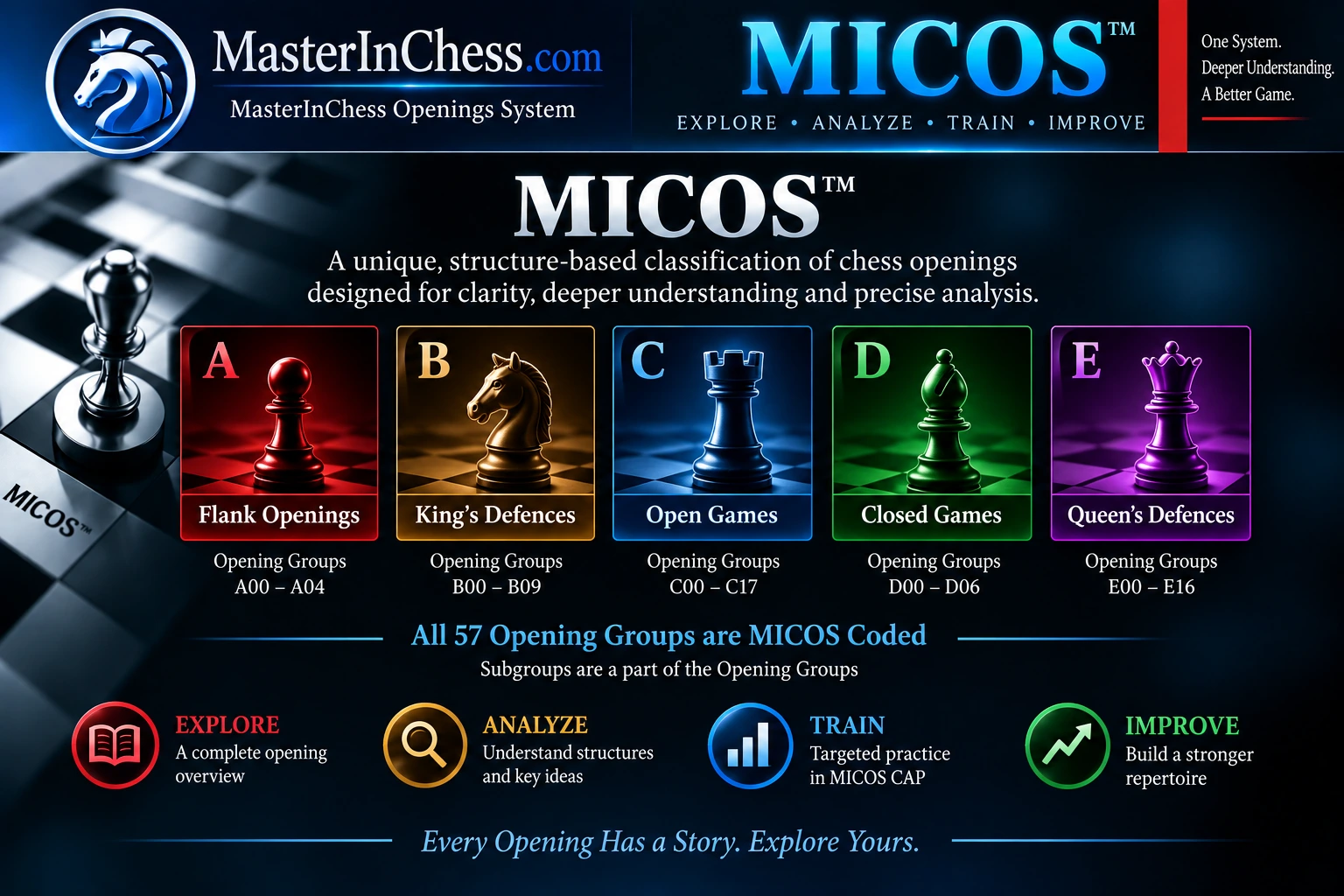
Click Image to Enlarge
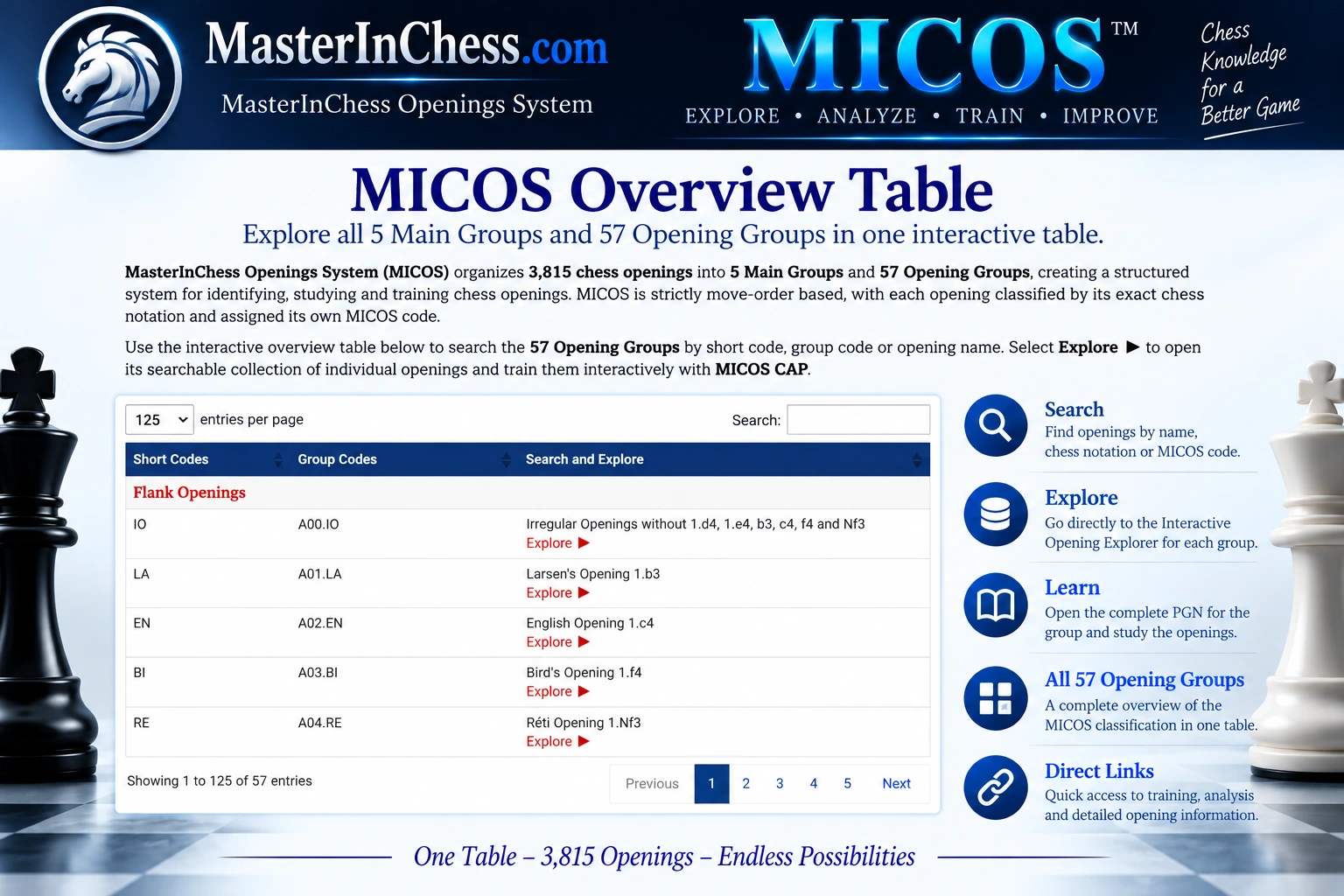
MICOS Overview Table
MICOS Overview Table presents the 5 Main Groups with the 57 Opening Groups in a structured format with search functionality. Each group is listed with its MICOS Short Code, MICOS Group Code, Opening Name and Main Chess Notation together with direct links to the Interactive Opening Explorer and searchable opening databases.
Use this table as the central navigation hub for MICOS. From here you can explore entire Opening Groups, or search individual openings by Opening Name, Chess Notation or MICOS Code and load them directly into MICOS CAP for interactive training.
Click Image to Enlarge
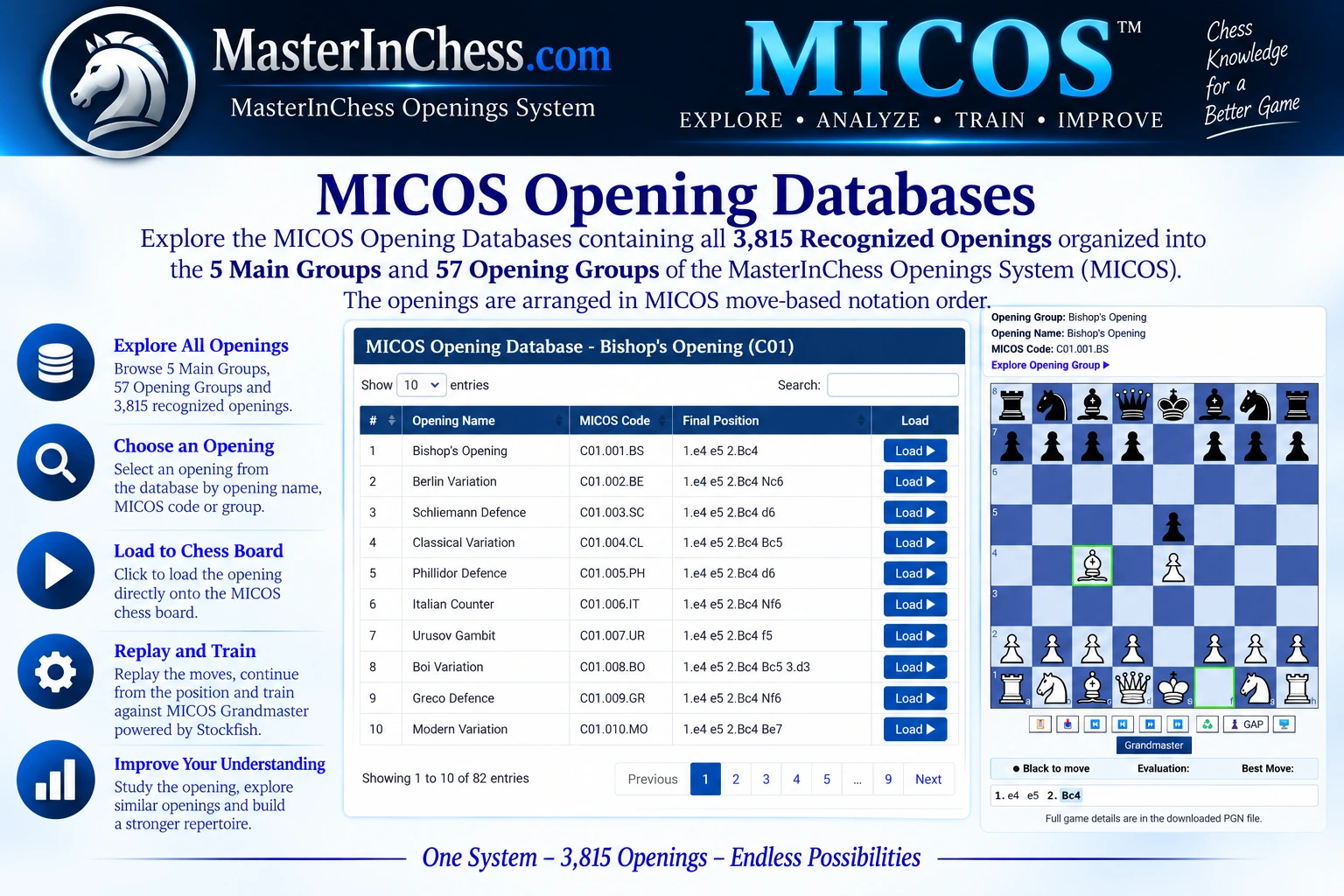
MICOS Opening Databases
Explore the MICOS Opening Databases containing all 3,815 Recognized Openings organized into the 5 Main Groups and 57 Opening Groups of the MasterInChess Openings System (MICOS). The openings are arranged in MICOS move-based notation order.
Select an opening from the database to load it directly onto the MICOS chess board. From there, you can replay the moves, continue from the position and train against MICOS Grandmaster powered by Stockfish.

Click Image to Enlarge
Grandmasters Chess Games
Grandmasters Chess Games by Openings presents carefully selected games organized across the 5 Main Groups and 57 Opening Groups with search functionality. Each group is listed with its MICOS Short Code, MICOS Group Code and direct links to the Grandmaster games and MICOS CAP.
Use this table as the central navigation hub for studying Grandmaster games by opening. From here you can examine how leading players handle each Opening Group, then search individual openings by Opening Name, Chess Notation or MICOS Code and load them directly into MICOS CAP for interactive exploration and training.
Click Image to Enlarge
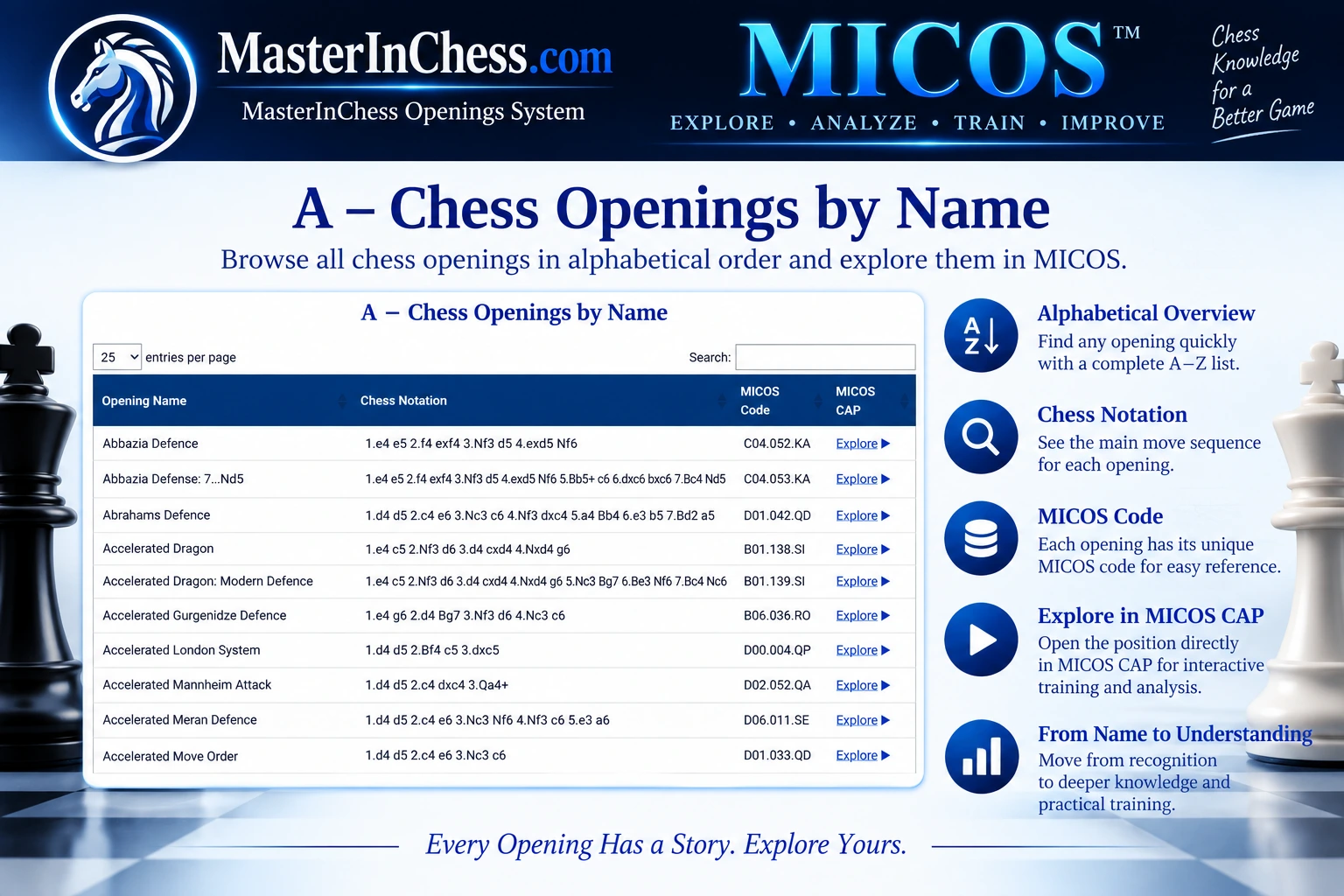
Openings by Name
Learn the connection between moves and the MICOS Code
When browsing openings by name, you’ll also see the starting chess notation and the MICOS Code. Over time, this helps connect move sequences (such as 1.e4 e6) with their structural opening family (French Defence) and its unique MICOS classification. The last two letters of every MICOS Code identify the Opening Group (for example, FR = French Defence).
Click Image to Enlarge
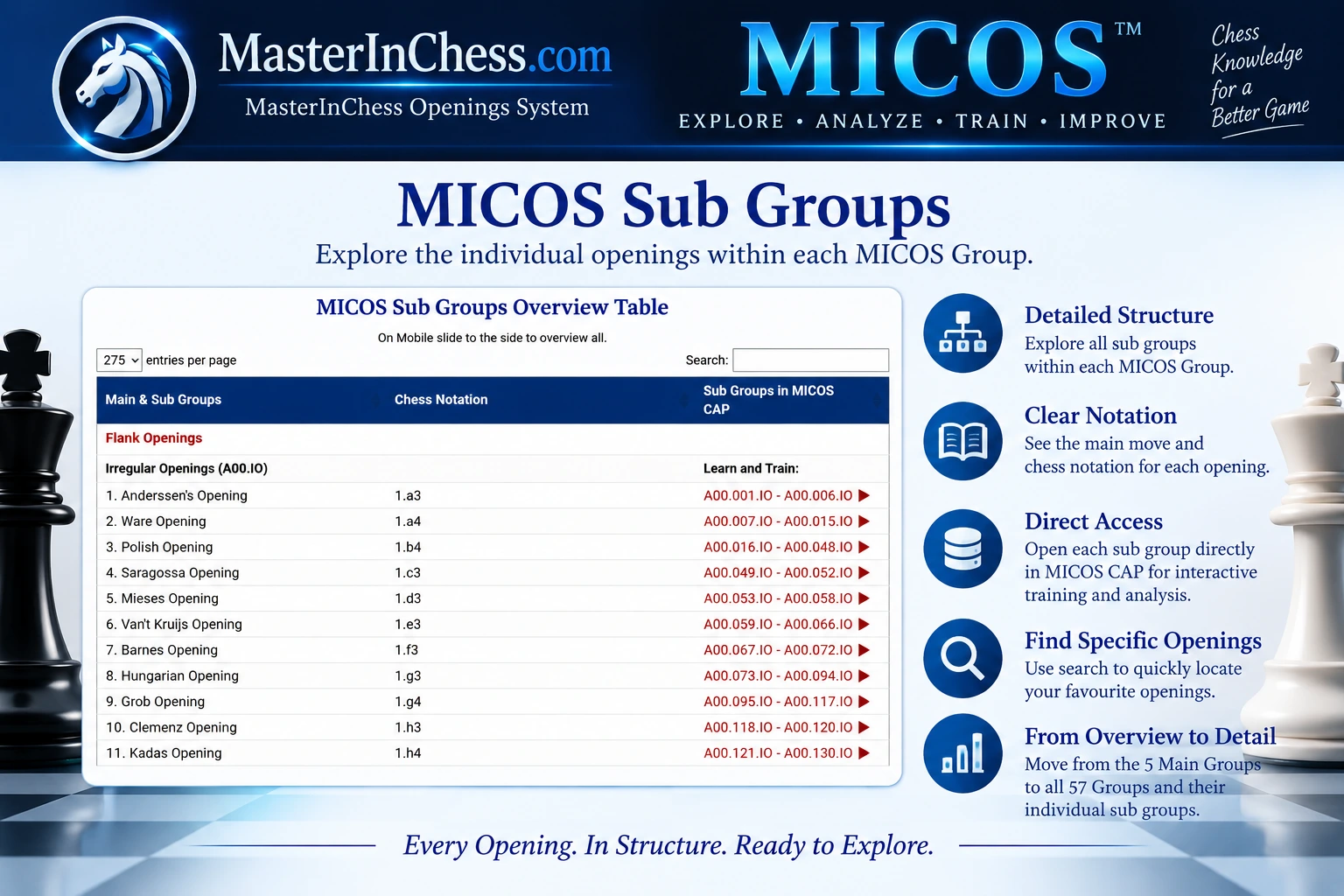
MICOS Sub Groups Overview Table
MICOS Sub Groups Overview Table presents all 166 MICOS Sub Groups in a structured format with search functionality. Each Sub Group is listed with its chess notation and MICOS code range, with direct links to PGN viewers that display the MICOS-coded openings on chess boards.
This table serves as a central reference for locating MICOS Sub Groups within their respective Opening Groups and for navigating efficiently between Sub Groups and the MICOS-coded openings they contain.
Click Image to Enlarge
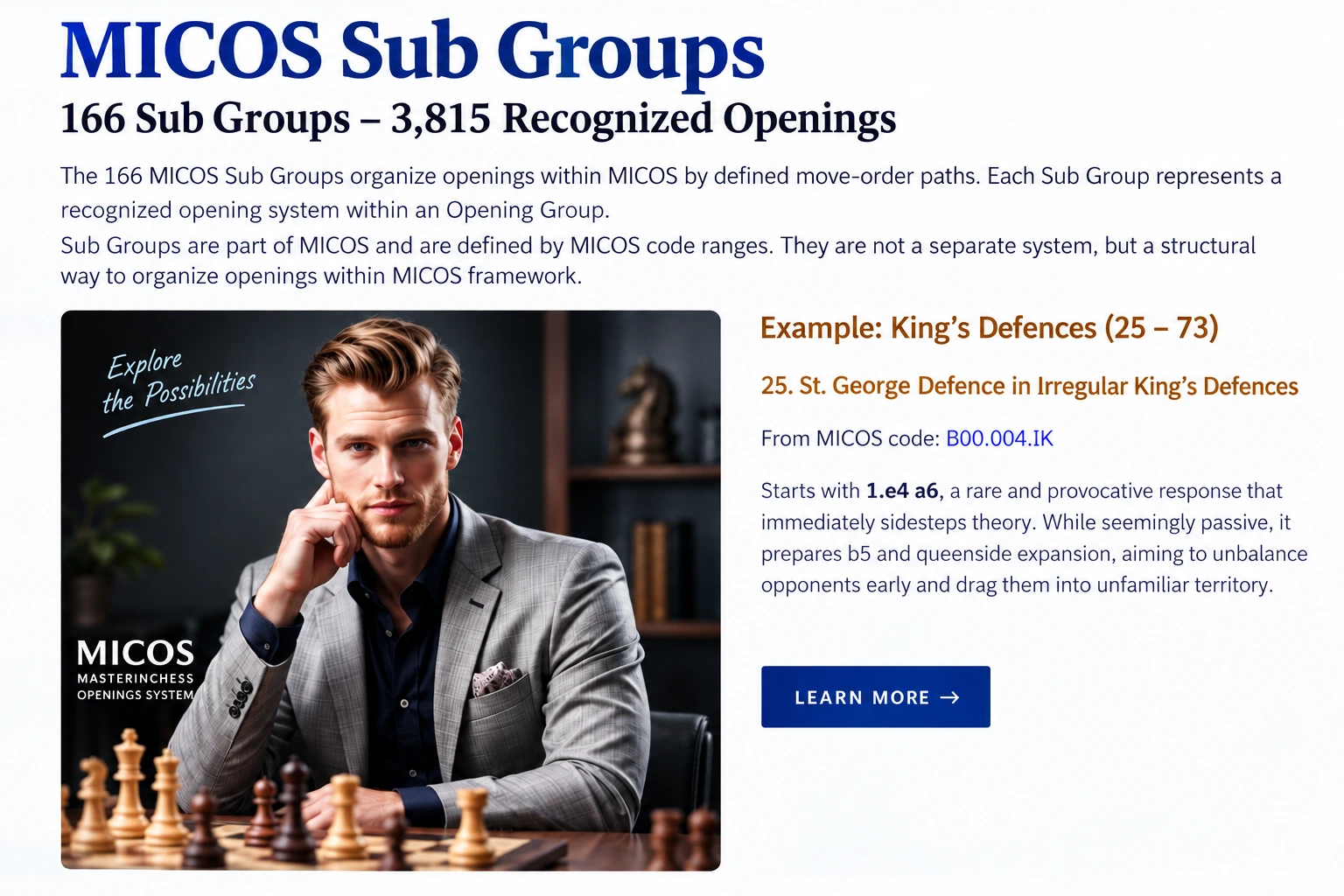
MICOS Sub Groups
The 166 MICOS Sub Groups organize openings within MICOS by defined move-order paths. Each Sub Group represents a recognized opening system within an Opening Group.
Sub Groups are part of MICOS and are defined by MICOS code ranges. They are not a separate system, but a structural way to organize openings within MICOS framework.
Click Image to Enlarge
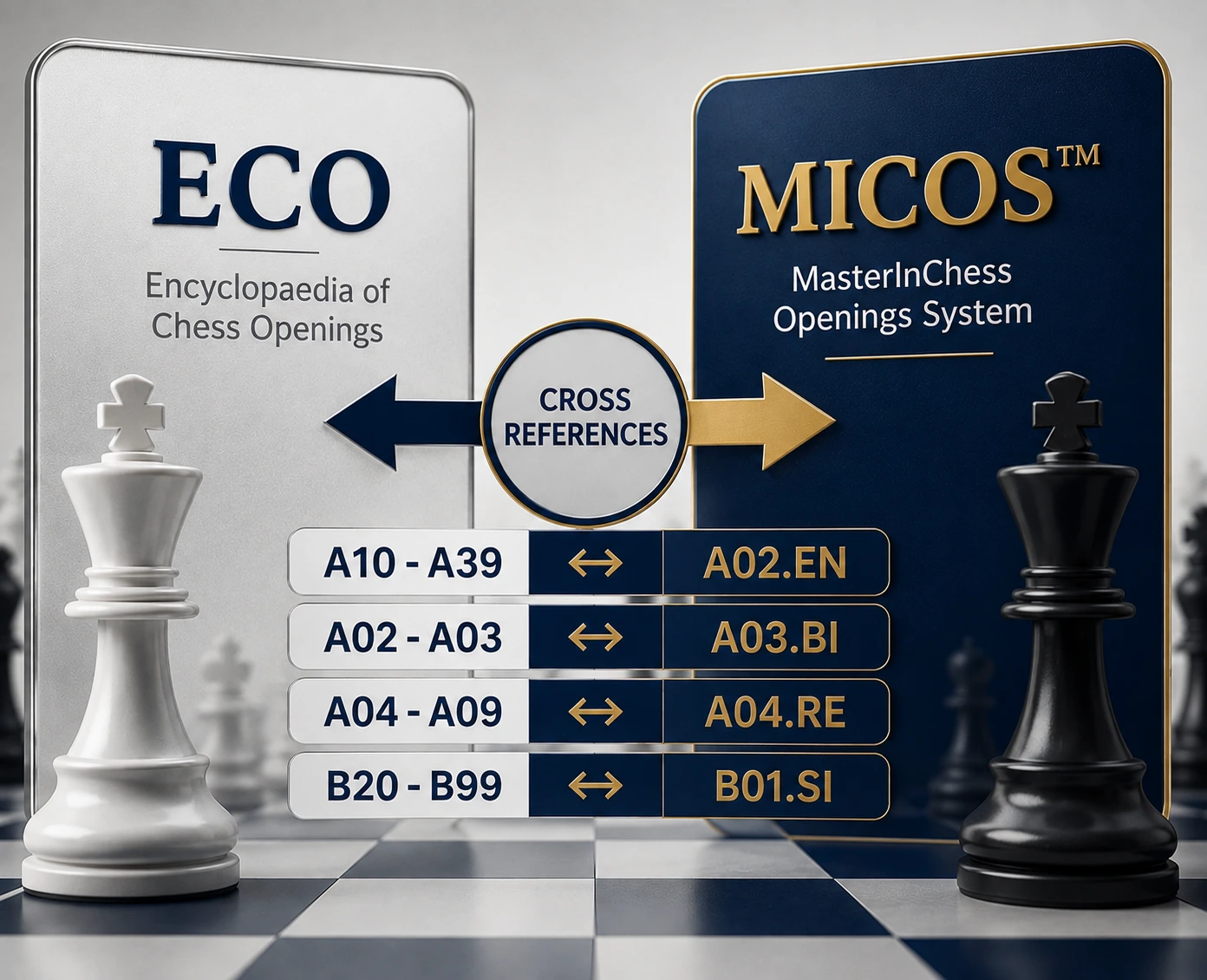
Cross References: ECO vs MICOS
The Cross References: ECO vs MICOS table provides a structured comparison between the 57 MICOS Opening Groups and the traditional ECO chess opening classification. Each Opening Group is listed with its MICOS Short Code, Opening Name, MICOS Group Code and corresponding ECO code or code range, together with direct links to the relevant opening databases.
Use this table to cross-reference familiar ECO classifications with MICOS and see how traditional ECO codes relate to the structure of the MasterInChess Openings System. From here you can explore the corresponding MICOS Opening Groups and their individual chess openings.

Click Image to Enlarge
What MICOS Is
This section introduces the MasterInChess Openings System (MICOS™) and explains why it was created as a modern alternative to the traditional ECO classification. It outlines how MICOS organizes chess openings by exact chess notation order, how openings are grouped and why the system is designed to be easier to understand and use.

MICOS™ — Official Documentation
This section explains what MICOS is, why it was created as a modern alternative to the ECO system and how the MICOS classification model is structured.
It introduces MICOS Opening Groups, Sub Groups, MICOS Code Ranges, MICOS Codes and explains how openings are identified by exact chess notation move order.
Use this page to understand the principles behind MICOS and how the system is applied across MasterInChess.com.
Click image to enlarge
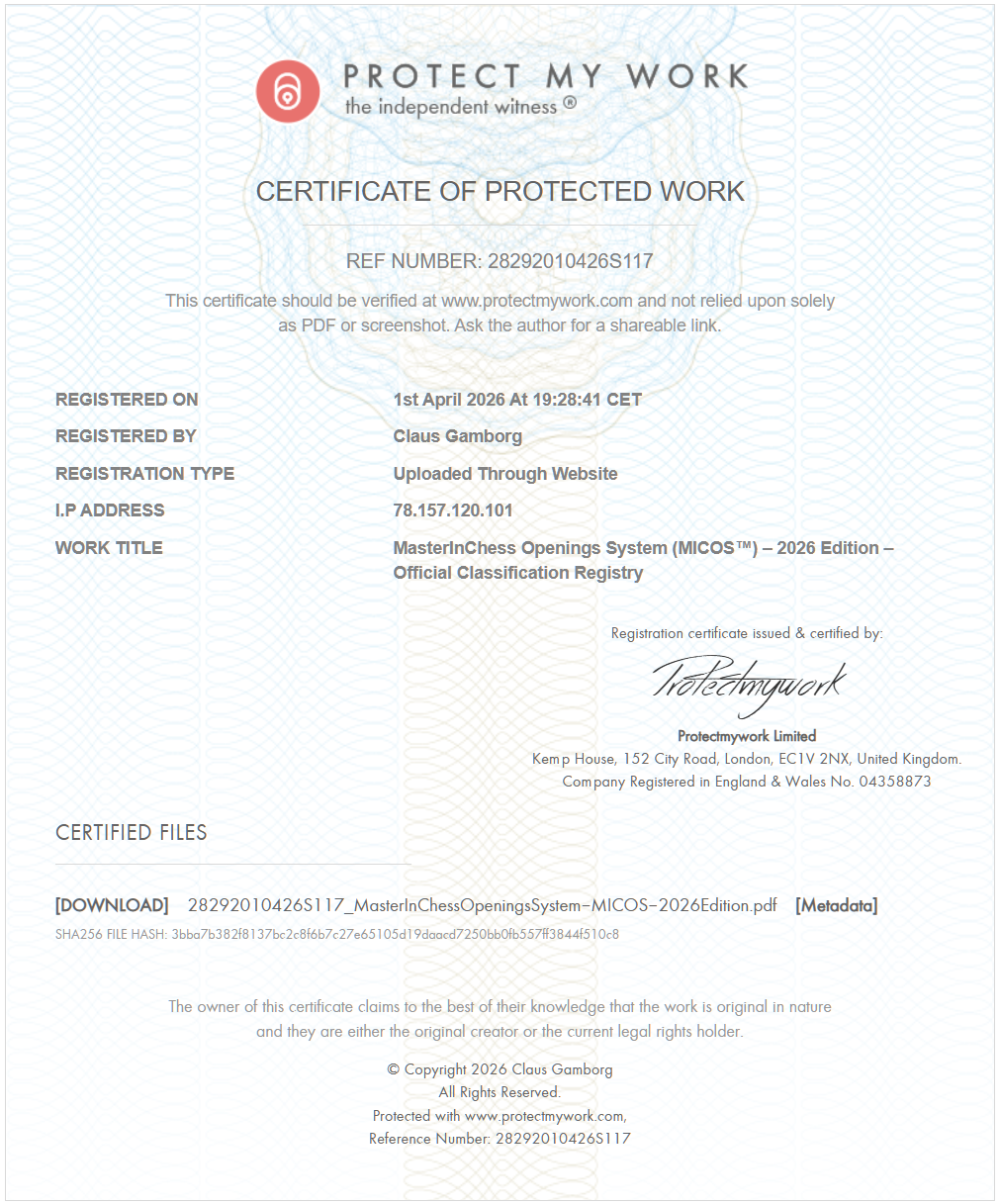
MICOS Copyright and Certification
MasterInChess Openings System (MICOS) — including Opening Names, Chess Notation, MICOS Codes, Main Groups, Opening Groups and Sub Groups — is officially registered and protected by copyright through ProtectMyWork.
This protection covers the original structure, classification logic, organization of MICOS and applies to professional use, training, publication and future MICOS development.