Build Your Opening Repertoire with MICOS or ECO?
MICOS Game Classification – Practical Example
This game was played at the British Chess Championships 2025.
[Event "111th ch-GBR 2025"]
[Site "Liverpool ENG"]
[Date "2025.08.02"]
[Round "1.1"]
[White "Jones Gawain C (ENG)"]
[Black "Sivanandan Bodhana (ENG)"]
[Result "1-0"]
[BlackElo "2233"]
[WhiteElo "2653"]

1. e4 e5 2. d4 exd4 3. Nf3 Nc6 4. Bc4 d6 5. Nxd4 Nxd4 6. Qxd4 Nf6 7. Nc3 Be7
8. Bf4 Be6 9. Bxe6 fxe6 10. e5 Nh5 11. Be3 dxe5 12. Qxe5 Nf6 13. Nb5 Bd6 14.
Qxe6+ Qe7 15. Qc4 Be5 16. O-O-O a6 17. Nd4 Bxd4 18. Rxd4 Qf7 19. Qc5 Qe7 20.
Qc4 Qf7 21. Qb4 Qe7 22. Qxb7 O-O 23. Rhd1 a5 24. Rc4 Rfc8 25. Qc6 Qf7 26. Bg5
Ne8 27. Rd7 Qxf2 28. Qe6+ Kh8 29. Rf4 Qc5 30. Rd5 Qg1+ 31. Rd1 Qc5 32. Qe5 Qd6
33. Rxd6 Nxd6 34. Bh6 Rg8 35. Rg4 Ne8 36. b3 Ra6 37. Bd2 Nf6 38. Ra4 Rc6 39.
Qxa5 h6 40. Rc4 Re6 41. Rxc7 Ne8 42. Rc8 Rf6 43. Qe5 Nd6 44. Rxg8+ Kxg8 45. a4
Kf7 46. Bb4 Nf5 47. g4 Nh4 48. Qd5+ Ke8 49. Qg8+ 1-0
Why Exact Opening Classification Matters for Coaches, Students and Chess Players
When this game is imported into Lichess, the downloaded PGN file classifies it as:
[ECO "C44"]
[Opening "Scotch Game: Scotch Gambit"]
In other words, Lichess identifies the game as a Scotch Game: Scotch Gambit (MICOS Code: C14.004.SG. Notation: 1.e4 e5 2.Nf3 Nc6 3.d4 exd4 4.Bc4).
The Scotch Game: Scotch Gambit begins:
1.e4 e5 2.Nf3 Nc6 3.d4 exd4 4.Bc4
But that is not the opening sequence played in this game.
The game actually began:
1.e4 e5 2.d4 exd4 3.Nf3
Based on the exact moves actually played, MICOS identifies the opening as:
Opening Group: Center Game
Opening Name: Kieseritzky Attack
MCO: C02.015.CG
Notation: 1.e4 e5 2.d4 exd4 3.Nf3
Lichess assigns ECO C44 – Scotch Game: Scotch Gambit to the same game.
Why This Matters for Training
If this game is treated as a Scotch Game: Scotch Gambit for training purposes, the Coach may prepare the Student for positions beginning with 1.e4 e5 2.Nf3 Nc6 3.d4 exd4 4.Bc4.
But that is not the opening sequence the Student played. The Student played 1.e4 e5 2.d4 exd4 3.Nf3, which MICOS identifies as Center Game: Kieseritzky Attack — C02.015.CG.
For practical opening preparation, the Coach should be able to identify and train the opening the Student actually played, including the opponent responses arising from that move order.
The larger problem is that different chess databases, programs and chess websites can classify the same game under different ECO Codes because their opening-classification methods and datasets differ. For a Coach trying to build a Student’s opening preparation, that ambiguity isn’t particularly helpful. Opening names can also create another layer of ambiguity, because the same chess opening notation may be known by different names in different databases and sources.
MICOS takes a different approach. The MICOS Code (MCO) reflects the moves actually played in the game. MICOS identifies the longest exact MICOS opening match and returns the Opening Group, Opening Name and MCO.
This gives the Coach a precise starting point for deciding what the Student should actually train.
Another – Practical Example
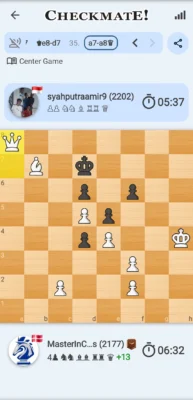
This game was played at club-player level on the Chess Online & Offline app.
[Event "Online Game"]
[Site "Checkmate Chess"]
[Date "2026.10.3"]
[Round "1"]
[White "MasterInChess"]
[Black "syahputraamir9"]
[Result "*"]
[TimeControl "600"]

1. e4 e5 2. d4 Nc6 3. d5 Nd4 4. Nc3 a6 5. a4 Bb4 6. Be3 Bxc3+ 7. bxc3 c5 8. cxd4 cxd4 9. Bd2 Nf6 10. Bd3 O-O 11. Nf3 d6 12. Bg5 h6 13. Bxf6 Qxf6 14. Rb1 Rb8 15. O-O Bg4 16. h3 Bxf3 17. Qxf3 Qxf3 18. gxf3 Rfc8 19. Rb6 Rd8 20. Kg2 g5 21. Rfb1 Rd7 22. Kg3 Kg7 23. Rg1 h5 24. h4 gxh4+ 25. Kxh4+ Kh6 26. Rg5 f6 27. Rxh5+ Kg6 28. Bxa6 Rh7 29. Rxh7 Kxh7 30. Rxb7+ Rxb7 31. Bxb7 Kg7 32. a5 Kf7 33. a6 Ke8 34. a7 Kd7 35. a8=Q *
When this game is imported into Lichess, the downloaded PGN file classifies it as:
[ECO "B00"]
[Opening "Nimzowitsch Defense: Kennedy Variation, Linksspringer Variation"]
In other words, Lichess identifies the game as a Nimzowitsch Defence: Kennedy Variation, Linksspringer Variation (MCO: B08.023.ND. Notation: 1.e4 Nc6 2.d4 e5 3.d5).
The Nimzowitsch Defence begins:
1.e4 Nc6
But that is not the opening sequence played in this game.
The game actually began:
1.e4 e5 2.d4
Based on the exact moves actually played, MICOS identifies the opening as:
Opening Group: King’s Pawn Game
Opening Name: Center Game
MCO: C00.017.KP
Notation: 1.e4 e5 2.d4
365Chess classifies the opening as ECO C20 – King’s Pawn Game / Center Game. This corresponds with the opening sequence actually played. Notice that 365Chess assigns ECO C20, while Lichess assigns ECO B00 to the same game.
Different Move Orders – The Same End Position for an Opening
An important distinction is that different opening move orders can lead to exactly the same chess position.
In this example, the game begins with the Center Game move order, but after 4.Bc4, it reaches the same position as the Scotch Game: Scotch Gambit — C14.004.SG.
MICOS identifies the opening through the exact move order played, while the final position can also be recognised as a position reached through another opening route.
For opening preparation, both are important: different move orders determine the decisions a player faces along the way, while the end position of an opening determines the position from which the player must continue. The next step is to study and train the tactical possibilities arising from that position.
Three Move Orders – The Same Chess Position
An experienced chess coach reviewing the examples above raised an important additional question: what happens when different opening move orders eventually transpose into exactly the same chess position?
The following three move orders provide a practical example.
A – Center Game Route
Chess Notation: 1.e4 e5 2.d4 exd4 3.Nf3 d6
MICOS identifies the opening as:
Opening Group: Center Game
Opening Name: Kieseritzky Attack
MCO: C02.015.CG
Notation: 1.e4 e5 2.d4 exd4 3.Nf3
365Chess: C21 – Center Game
Lichess: ECO C41 – Philidor Defence: Exchange Variation
B – Philidor Defence Route
Chess Notation: 1.e4 e5 2.Nf3 d6 3.d4 exd4
MICOS identifies the opening as:
Opening Group: Philidor Defence
Opening Name: Exchange
MCO: C07.010.PH
Notation: 1.e4 e5 2.Nf3 d6 3.d4 exd4
365Chess: ECO C41 – Philidor Defence
Lichess: ECO C41 – Philidor Defence: Exchange Variation
C – Irregular Queen’s Defences Route
Chess Notation: 1.d4 d6 2.Nf3 e5 3.e4 exd4
MICOS identifies the opening as:
Opening Group: Irregular Queen’s Defences
Opening Name: Rat Defence
MCO: E00.008.IQ
Notation: 1.d4 d6
365Chess: Initially classifies this move order under ECO A41. After 3.e4, its classification changes to ECO C41 – Philidor Defence. The continuation 3…exd4 was not available in the 365Chess opening explorer used for this comparison.
Lichess: ECO C41 – Philidor Defence: Exchange Variation
Three Different Routes – One Position
Despite beginning through three different opening routes, all three move orders reach exactly the same chess position after Black’s third move.
FEN:
rnbqkbnr/ppp2ppp/3p4/8/3pP3/5N2/PPP2PPP/RNBQKB1R w KQkq - 0 4
Lichess classifies all three at this point as ECO C41 – Philidor Defence: Exchange Variation.
MICOS preserves the opening history created by the moves actually played. The three games therefore retain three different MICOS classifications even though they eventually transpose into the same position.
Why This Matters for Building an Opening Repertoire
This distinction becomes important when a Coach prepares a Student for future games.
If the Student is trained only for the Philidor Defence because the final position is classified as C41, that preparation may cover what to do after the transposition has occurred, but it does not necessarily prepare the Student for the different routes leading to that position.
For example, the third route begins:
1.d4 d6
The opponent is under no obligation to continue with the moves that eventually transpose into the Philidor Defence position. The game may continue through a completely different opening path before that transposition ever occurs.
An experienced chess coach reviewing these examples made an important distinction:
- The position tells us what we face, but the move order tells us how we got there — and both matter.
For opening repertoire training, this suggests that a chess player should understand both the opening route leading towards a position and the position itself.
MICOS provides the opening identity by identifying the longest exact MICOS opening match in the moves actually played.
When different opening move orders transpose into the same position, the player who recognises that position can draw on familiar preparation. But before the transposition occurs, each opening route may contain different opponent responses and different decisions that need to be understood and trained.
If a chess program or chess website identifies only the final transposed opening classification based on the FEN end position, how can coaches and chess players identify the different opening routes that can reach the position and prepare for them?
MICOS™ is the proprietary chess classification system developed by MasterInChess and protected by international copyright law.
You are welcome to use and share MICOS for personal, educational and non-commercial purposes. Commercial use or integration requires permission from MasterInChess.